Give the gift of self-knowledgeChoose a gift card
Astrology15 min read

Astrology transits explained: why some months feel different

A transit is a planet in today’s sky making an angle to a planet in your birth chart. Your chart never changes, but the sky keeps moving, and transits are how astrologers explain why one season feels easy and another feels like work. Here’s how they work and how to read yours.

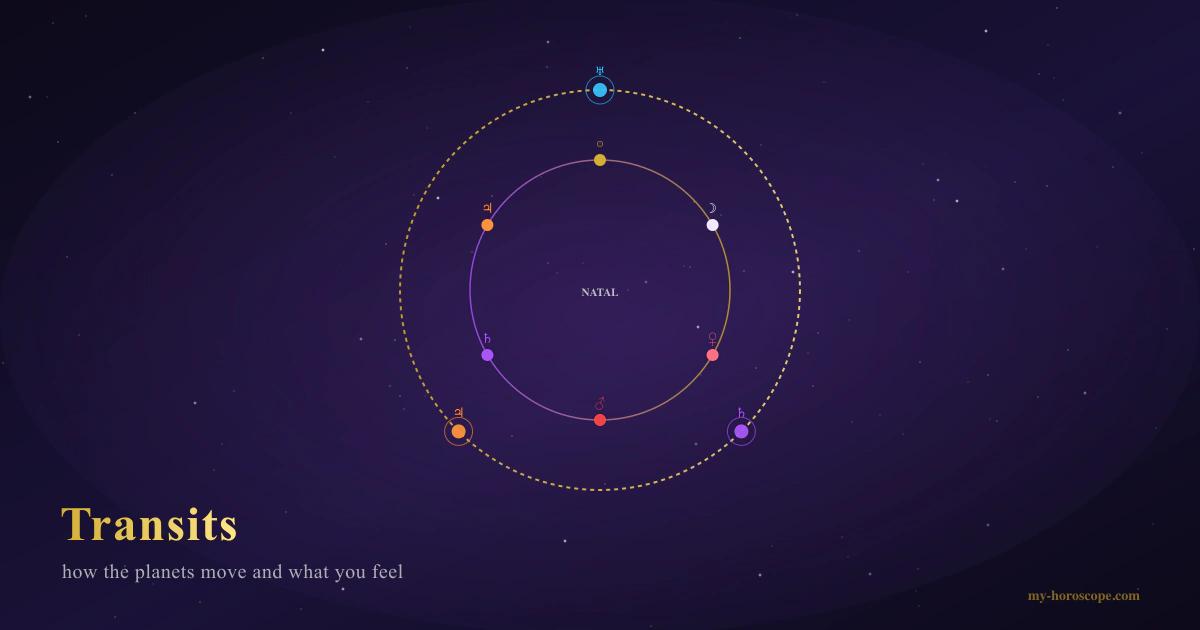
Astrology transits: moving planets on an outer ring around a fixed birth chart
Inner wheel: your birth chart, which never changes. Outer wheel: where the planets are right now.
1

What is a transit in astrology?

A transit is what happens when a planet in today’s sky forms a meaningful angle to a planet or point in your birth chart. Your chart is fixed at the moment you were born. The real planets keep moving. Transits compare the two, and astrologers use them to describe what a given stretch of your life tends to feel like.

Your birth chart is a snapshot of the sky at your first breath. It’s static: every planet stays where it was. A transit is the moving sky checking in with that snapshot. If Saturn today sits at the same degree your Moon occupied when you were born, you’re having a Saturn transit to your natal Moon. Saturn stands for tests, structure, and growing up. The Moon is your emotional self. So astrologers expect a period of emotional maturing: sometimes heavy, usually clarifying.

Transits are the reason astrology can talk about what’s happening now and not only who you are. Without them, a chart would be a portrait hanging on a wall. With them, it reads more like a calendar. If you need the basics first, start with what a horoscope is and how it works, since transits build on everything else.

2

How long do transits last? Fast and slow planets

The planets move at very different speeds, so their transits last anywhere from a few hours to a few years:

  • The Moon: about two and a half days per sign. A Moon transit to one of your planets lasts a few hours. You feel it as the mood of a day, never as a turning point.
  • The Sun, Mercury, and Venus: roughly three to five weeks per sign. These are daily and weekly nudges. You notice them as “I got a lot done” or “that was a sweet week for us.”
  • Mars: about six to eight weeks per sign. Mars transits bring energy and sometimes friction. They often kick off something you’ve been putting off.
  • Jupiter: about one year per sign. Jupiter runs a 12-year cycle of growth and opportunity, opening doors in one house of your chart at a time.
  • Saturn: about two and a half years per sign. Saturn brings discipline, tests, and building. Its full cycle takes 29 to 30 years, and its homecoming is the famous Saturn return.
  • Uranus: about seven years per sign. Uranus is linked with sudden turns, freedom, and changes in how you define yourself.
  • Neptune: about 14 years per sign. Neptune blurs and dissolves. Old certainties get hazy, and imagination and faith get louder.
  • Pluto: 12 to 30 years per sign. Pluto is the slow transformer. A single Pluto transit to one of your planets can last two to three years.

Rule of thumb: the slower the planet, the bigger the transit. A Moon transit colors your afternoon. A Pluto transit can reshape a whole chapter of your life.

3

What is a Saturn return, and when does it happen?

Saturn takes about 29.5 years to circle the Sun. When it comes back to the exact place it held at your birth, you’re in your Saturn return, which astrologers describe as the real start of adulthood.

The first Saturn return arrives between ages 27 and 30 (the exact timing depends on your chart, and most people feel it for a year or more). The second comes around 58 to 60. The third, if you get there, around 88.

Themes people commonly report around the first one:

  • The end of a relationship that had stopped growing.
  • A career change, or leaving the job you took after college and stayed in out of inertia.
  • A serious reckoning with a parent or another authority figure.
  • The question “who am I, and what am I doing with my life?” at full volume.
  • Big commitments: marriage, a first home, a first child. Saturn likes structure.

None of these is guaranteed, and a Saturn return isn’t bad luck. What it tends to bring is a reality check. What’s solid stays. What was built on a shaky base gets rebuilt. Plenty of people look back on those years as the time their adult life took its real shape.

The second Saturn return, in your late fifties, is usually more deliberate. It raises the question of how you want to grow older: what to keep carrying, what to hand off, and what you still want to build.

4

What does a Jupiter transit mean?

If Saturn is the stern teacher, Jupiter is the generous one. Its transits get described as blessings, but an open door is closer to the truth. Luck won’t carry you through it. You still have to walk.

Jupiter spends about a year in each sign and takes 12 years to pass through all of your houses. When it crosses your 1st house, astrologers expect a year of personal growth: you’re more visible and more confident. In the 2nd house, the theme is income and what you value. In the 7th house, an important partnership, in love or in business. In the 10th house, recognition at work.

Jupiter crossing your natal Sun, which happens about once every 12 years, is traditionally read as one of the best years of the cycle. You tend to feel more like yourself. Jupiter in a trine to your natal Venus often marks a warm stretch for love, friendship, or creative work.

One warning: Jupiter expands whatever it touches, including the things you’d rather keep small. It’s easy to overspend, overcommit, or overestimate under Jupiter. Use the opening on purpose.

To see where Jupiter is in your own chart, sign up for free and enter your birth date, time, and place. The birth chart and your personal transits (what’s active right now, what it tends to feel like, and how to work with it) are part of the Cosmos plan in our membership.

5

What do Uranus, Neptune, and Pluto transits feel like?

Uranus, Neptune, and Pluto are the outer planets. Their transits are slow, and astrologers link them with the changes that leave you a different person on the other side.

Uranus is associated with sudden freedom. Uranus transits often coincide with leaving a job, a relationship, or a city, or with changing fields altogether. Uranus doesn’t look back.

  • Uranus square natal Uranus (around age 21, and again around 63): a push to redefine who you want to be.
  • Uranus opposite natal Uranus (around age 42): astrology’s version of the midlife crisis. The marriage gets questioned, the motorcycle gets bought, the career gets swapped.

Neptune dissolves. What was firm turns foggy. Under Neptune you can lose your bearings, and you can also open up to art, faith, and compassion in a new way. Its shadow side is illusion and escapism, so it’s a good time to be honest with yourself about what you’re avoiding.

  • Neptune square the Sun: a stretch of low energy and confusion about who you are, sometimes the start of a spiritual search.
  • Neptune on the ascendant: your self-image goes soft for a while, and the old one may not fit when the fog lifts.

Pluto is the most intense. A Pluto transit is read as clearing out what holds you back and rebuilding from there. Pluto on the natal Sun is the classic “death and rebirth” of identity. People who’ve been through it often call those years the hardest of their lives and also the time they finally found themselves.

Take outer-planet transits seriously, and don’t go through them alone. If a period like this is hitting hard, a therapist, a mentor, or a trusted friend will help more than any chart can.

6

Are transits good or bad? Easy and hard aspects

Transits use the same angles as natal aspects. Sextiles and trines are the easy ones. Squares and oppositions are the hard ones. A conjunction is neutral in tone and usually the strongest of all.

An easy transit, such as Jupiter trine your natal Venus, opens things up. You’re in the flow and things work. The risk is that you coast and miss it. When a transit is on your side, use it. The next one like it may be years away.

A hard transit, such as Saturn square your natal Sun, makes you work. You run into obstacles, frustration, sometimes sadness. The advice here is to go through it on purpose and not look for a way around. Astrologers treat a hard angle as the engine of growth: it shows you exactly what needs attention.

A practical habit: when everything seems to be shifting and you can’t say why, look at your transits. Often a slow planet such as Saturn or Pluto is closing in on one of your key planets, and seeing that on the page makes the period easier to name.

7

What are the major transits in 2026 and 2027?

Transits touch whole generations, too. When a slow planet enters a new sign, the collective theme shifts for years. Here’s what’s shaping 2026 and 2027, based on where the planets really are:

  • Pluto in Aquarius (2024 to 2044). After 16 years in Capricorn, Pluto settled into Aquarius in November 2024 for the first time since the late 1700s. It stays until January 2044. Astrologers connect it with deep change in technology, networks, and how communities organize and share power.
  • Saturn in Aries (February 2026 to April 2028). Saturn left Pisces for good in February 2026. In Aries, the theme is responsible beginnings: courage with a plan, and leadership that has to prove itself.
  • Neptune in Aries (from January 2026). Neptune is back in Aries for the first time since the 1870s. Saturn and Neptune met at the very start of Aries on February 20, 2026, their first conjunction since 1989, which astrologers read as a reset between ideals and reality.
  • Uranus in Gemini (from April 2026). Uranus moved into Gemini for the next seven years or so. Expect the theme of fast change in how people learn, talk, and get their information.
  • Jupiter in Cancer, then Leo, then Virgo. Jupiter was in Cancer (home, family, roots) until the end of June 2026. It’s in Leo (creativity, confidence, the heart) until late July 2027, then moves into Virgo (work, health habits, useful skills).
  • The lunar nodes in Aquarius and Leo (summer 2026 to early 2028). The nodal axis works on the “me and we” question: personal expression on one end, the group on the other. More in our guide to the North Node and South Node.

How these land for you depends on where they fall in your own chart. Pluto in Aquarius does its work in whichever house Aquarius covers for you. Saturn in Aries puts weight on your Aries house and any planets you have there.

8

How do you read your own transits?

Transit work may be the most practical part of astrology, because it answers the question “why now?” A simple order to follow:

  1. Start with your birth chart. You can’t read transits without it, because you need to know where they land. On My Horoscope, you enter your details when you sign up for free. The full chart and personal transits are in the Cosmos plan.
  2. Look at the slow planets first. Saturn, Uranus, Neptune, and Pluto give you the long view: what this period is about, now and for the next few years.
  3. Check what they touch. Transits to your personal planets (Sun, Moon, Mercury, Venus, Mars) are the ones you feel most. If Saturn sits exactly on your natal Venus, expect relationships or money to be tested and clarified.
  4. Watch the sensitive points. The rising sign (ascendant), the Midheaven, and the lunar nodes. Pluto crossing the ascendant is read as a deep change in identity. Uranus on the Midheaven often coincides with a sudden career turn. These need an exact birth time.
  5. Follow the Moon for the day-to-day. The Moon crosses your whole chart in about 27 days. In your 1st house, you’re more visible. In your 12th, you pull inward. This layer sets the tone of each day.

A note on orbs: a transit is strongest when it’s exact and is usually counted within a degree or two on either side. Slow planets also turn retrograde, so one transit can make three passes over the same point across several months.

If you’d rather have this done for you, the Cosmos plan ($7.49 per month) follows your personal transits as they happen: which one is active, what it tends to mean, and what to do with it. It’s built from your data and your chart, not from a forecast for your whole sign.

Transits only make full sense together with the natal chart. The planets move through your 12 houses, and the house decides which area of life a transit shows up in. To see what a full chart includes, visit the birth chart page.

Create a free account →

Frequently asked questions

Q:What is a transit in astrology?

A transit is a planet’s current position in the sky forming an angle (an aspect) to a planet or point in your birth chart. Astrologers say it activates that part of your chart for as long as the angle lasts. Transits are how astrology describes the current period of your life and not only your character.

Q:How long does a transit last?

It depends on the planet. Moon transits last a few hours, Sun, Mercury, and Venus transits a few days, and Mars about a week or two. Jupiter transits last a few weeks to a few months. Saturn, Uranus, Neptune, and Pluto can stay within range for many months to two or three years, often in three passes because of retrogrades.

Q:What is a Saturn return?

A Saturn return happens about every 29.5 years, when Saturn comes back to the position it held at your birth. The first arrives between ages 27 and 30 and is seen as the threshold of real adulthood, often with big decisions about work and relationships. The second comes around 58 to 60, and the third around 88.

Q:Can transits predict events?

Not specific events. Transits describe themes and timing, not outcomes. Saturn on your natal Venus doesn’t predict a breakup. It suggests a period when relationships get tested. Whether a relationship ends, matures, or gets rebuilt is up to the people in it. Treat transits as weather reports for reflection, never as fixed forecasts.

Q:Which transits are the most important?

Three things decide how strongly you feel a transit: how slow the moving planet is (Pluto far more than the Moon), which natal planet it touches (the Sun and Moon are most sensitive), and the aspect (conjunctions, squares, and oppositions stand out more than sextiles). Transits to your rising sign, Midheaven, or lunar nodes also carry extra weight.

Q:What should you do during a Saturn square?

A Saturn square to a personal planet can run for several months and often feels like a block or a test. Treat the friction as information. Focus on structure, keep your commitments, and finish what you’ve started before taking on big new obligations. Astrologers say you tend to come out of it steadier and clearer about your limits.

Q:How long is Pluto in Aquarius?

Pluto first entered Aquarius in March 2023, dipped back into Capricorn twice, and has been in Aquarius continuously since November 2024. It leaves for Pisces in March 2043, returns briefly, and exits for good in January 2044. That’s about 20 years, which astrologers link with long-term change in technology and community.

Get a horoscope written for you

Sign up for free and get a daily horoscope based on your birth chart, a tarot card of the day, and deeper readings.