Give the gift of self-knowledgeChoose a gift card
Astrology14 min read

North Node and South Node: what they mean in your chart

The North Node and South Node are two opposite points in your birth chart where the Moon’s path crosses the Sun’s. Astrologers read the South Node as what comes naturally to you and the North Node as the direction you’re here to grow in. Here’s how to read yours by sign and house.

Lunar nodes in astrology: the North Node and South Node as an axis across the birth chart
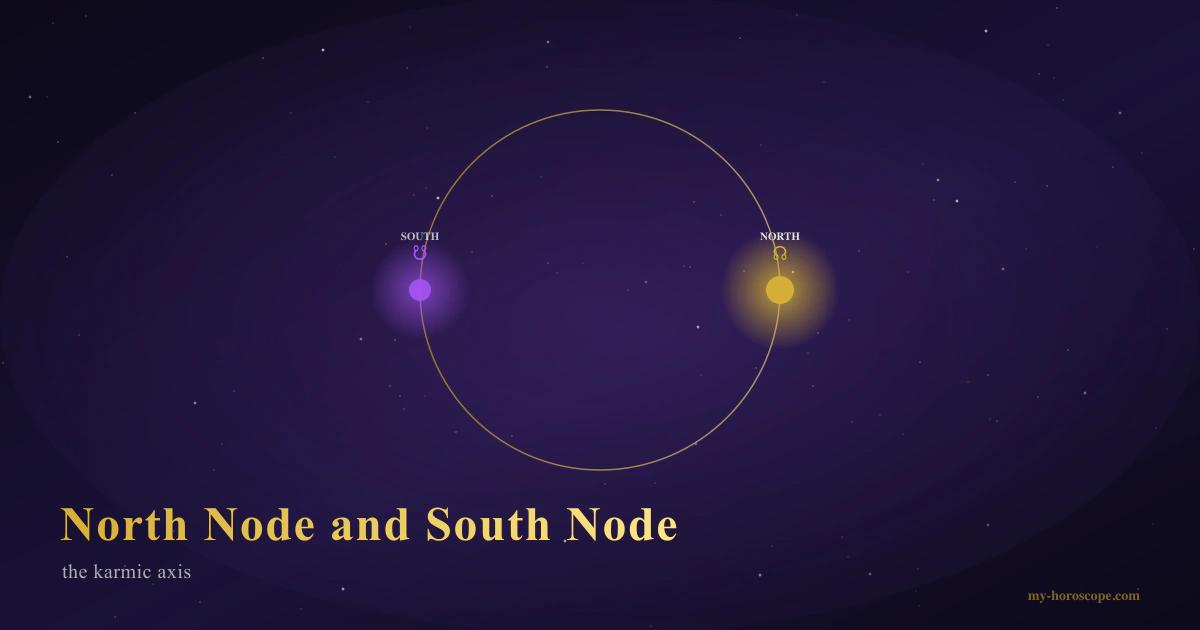
The North Node (☊) and South Node (☋) always sit exactly opposite each other, forming one axis across your chart
1

What are the North Node and South Node?

The North Node and South Node, together called the lunar nodes, are the two points where the Moon’s orbit crosses the ecliptic, the Sun’s apparent path through the sky. In astrology, the South Node stands for what you already know how to do, and the North Node for the direction you’re meant to grow in. Together they work like a compass laid across your birth chart.

In a chart you’ll see them as two symbols among the planets: ☊ (North Node) and ☋ (South Node). They aren’t planets or bodies of any kind. They’re calculated points. The North Node is where the Moon crosses the ecliptic heading north, and the South Node is where it crosses heading south. Solar and lunar eclipses can only happen when a new or full moon falls close to one of them.

The two nodes are always exactly 180° apart, so they form a single axis through the chart. Modern astrologers give that axis one of the deepest meanings in the whole chart: where you’re coming from and where you’re headed.

The idea is old. Greek-speaking astrologers of antiquity already tracked the nodes because of eclipses, and medieval astrologers called them the Dragon’s Head and the Dragon’s Tail. In Indian (Vedic) astrology they’re Rahu (North Node) and Ketu (South Node), and they carry as much weight as the planets. The reading most Western astrologers use today, the nodes as a guide to purpose and growth, took shape in the 20th century, influenced by theosophy and by writers such as Dane Rudhyar and Martin Schulman.

If you’re new to astrology, start with what a horoscope is and our guide to the houses. The nodes make the most sense once you can see the whole chart.

2

What does the South Node mean?

The South Node represents the past. In karmic astrology, that means what the soul carries from earlier lives: abilities, habits, and patterns you seem to have been born with. If reincarnation isn’t your thing, read the South Node as inheritance: the skills and reflexes your family and early life handed you ready-made.

The South Node is where you run on autopilot. It’s so natural that you don’t even count it as a talent. Everyone can do this, right? They can’t. Your South Node is your comfort zone, and astrologers read the chart as nudging you to step out of it.

Here’s the catch: what the South Node offers is easy to love and hard to grow from. It’s the job that bores you because you can do it half asleep. The relationship that feels safe and never stretches you. The strategy that used to work and now holds you back.

Think of it as your hometown. You know every street, and going back always feels good. Nothing’s wrong with visiting. The trouble starts only when you never leave.

3

What does the North Node mean?

If the South Node is the past, the North Node is the direction ahead. It points to the qualities you’re here to develop. Because they’re new, they’re uncomfortable. North Node territory usually isn’t fun at first: you’re clumsy there, you don’t know the rules, and you’d rather go back to what you’re good at.

An example: someone with the South Node in Aries and the North Node in Libra knows how to make decisions alone and push through a crisis solo (Aries). Their growth edge is to cooperate, compromise, and lean on a partner (Libra). Early in life, a person like this is often a lone fighter. Later they learn that some things only work with two.

The North Node is a direction, not a destination. You never finish it like a task on a list. It’s a steady lean away from what’s comfortable and toward what makes you grow.

If something keeps calling you and you can’t quite explain why, your North Node is a good place to look. It often describes exactly the thing that makes the old version of you feel a little too small.

4

What does your North Node sign mean? The six nodal axes

The nodes always travel as a pair. If your North Node is in Leo, your South Node is in the opposite sign, Aquarius. That gives six axes, each readable in two directions:

  • Aries and Libra. North Node in Libra (South in Aries): you’re learning to cooperate, listen, and share the decision. North Node in Aries (South in Libra): you’re learning to stand up for yourself and act on what you want without waiting for approval.
  • Taurus and Scorpio. North Node in Scorpio (South in Taurus): you’re learning to loosen your grip on comfort and security and let real change in. North Node in Taurus (South in Scorpio): you’re learning to build calm and stability after a lot of intensity.
  • Gemini and Sagittarius. North Node in Sagittarius (South in Gemini): you’re learning to move past collecting facts and commit to a bigger view. North Node in Gemini (South in Sagittarius): you’re learning to stay curious, ask questions, and explain what you know in everyday words.
  • Cancer and Capricorn. North Node in Capricorn (South in Cancer): you’re learning to step out of the family nest and build authority of your own. North Node in Cancer (South in Capricorn): you’re learning to put down the armor and let people get close.
  • Leo and Aquarius. North Node in Aquarius (South in Leo): you’re learning to put your gifts to work for a group or a cause. North Node in Leo (South in Aquarius): you’re learning to step out of the crowd and show who you are.
  • Virgo and Pisces. North Node in Pisces (South in Virgo): you’re learning to ease up on perfectionism and trust your intuition. North Node in Virgo (South in Pisces): you’re learning to bring drifting ideas down to earth with practical, daily work.

People who live out your North Node sign easily often attract you and frustrate you in equal measure, because they do without effort what you’re still learning. That’s useful to know in love and in friendship. For more on how signs get along, see our zodiac compatibility guide.

5

What does your North Node house mean?

The houses of the nodes matter as much as the signs. The sign describes how a node works. The house describes which area of life it plays out in. You need your birth time to know the houses.

Say your South Node is in the 4th house and your North Node is in the 10th. The pull is from the safety of home toward a public role. People with this axis often stay close to family for a long time, pour themselves into taking care of others, and avoid career risks. Stepping into public view usually comes later, and it rarely feels comfortable at first.

Flip it, and a North Node in the 4th house says: after years of building a career and a public identity, the growth is in coming back to your roots, your home, and your family.

A quick guide to the other house pairs: the 1st and 7th are about self and partnership, the 2nd and 8th about your own resources and shared ones, the 3rd and 9th about everyday learning and big-picture meaning, the 5th and 11th about personal creativity and community, and the 6th and 12th about daily work and inner life.

One caution: the nodes don’t tell you where fame or success is waiting. They show where you’re asked to be a beginner again. We cover each house in detail in our guide to the 12 houses.

6

How are the lunar nodes connected to eclipses?

Eclipses happen only when the Sun, the Moon, and a node line up: a new moon near a node gives a solar eclipse, and a full moon near a node gives a lunar eclipse. That’s where the dragon came from. In old stories, a dragon swallows the light, and the nodes are its head and tail.

Eclipses come in “seasons” roughly every six months, always in the signs where the nodes currently are. The nodes move backward through the zodiac (against the direction of the planets) and stay in one pair of signs for about 18 months. From early 2025 the North Node was in Pisces and the South Node in Virgo. In the summer of 2026 the axis shifted to Aquarius (North Node) and Leo (South Node), where it stays until early 2028. That’s why the total solar eclipses of August 12, 2026, and August 2, 2027, both fall in Leo, and the annular solar eclipse of February 6, 2027, falls in Aquarius.

When an eclipse lands on your natal nodes or a planet close to them, astrologers expect that period to stand out: changes in relationships, work, or where you live seem to cluster around those weeks. Nobody can promise an event, and an eclipse isn’t something to fear. Read it as a chapter break, a time when things that were building slowly tend to come to a head.

Slow planets crossing your nodal axis are read as long, formative stretches. Saturn on a node tends to bring a test of commitment. Pluto on a node tends to coincide with a deep rethink of who you are. We explain how these work in our guide to transits.

7

What is a nodal return? Milestones around ages 18, 37, and 56

The nodes move backward through the zodiac at about 1.6° a month and complete a full circle in about 18.6 years. So they come back to their natal position when you’re about 18 and a half, again around 37, around 56, and once more around 74. Each of these is called a nodal return. Halfway between them, around ages 9, 28, and 46, the nodes swap places, which astrologers call a reverse nodal return.

The first nodal return, at 18 or 19, lines up with the threshold of adulthood: finishing high school, leaving for college or a first full-time job, the first serious relationship. It’s often when you first choose, without quite knowing it, between the familiar South Node road and the North Node one.

The second, at 37, comes several years after the first Saturn return (around 29). By then many people have already changed jobs, rethought a relationship, or moved. If you’ve been building mostly on your South Node, the second nodal return tends to put the question to you directly.

The third, around 56, is read as a time of maturity and integration. The two ends of the axis stop feeling like opposites. What once seemed impossible to combine starts working together.

These milestones are one reason certain years bring on the question “who am I, and what am I doing here?” Astrology gives those phases a name, which makes them easier to work with on purpose.

8

How do you follow your North Node in real life?

Living toward your North Node takes deliberate effort, because the South Node is always the easier option. Astrology doesn’t hand you a script here. It gives you a direction, and you decide what to do with it. Five practical ways to start:

  1. Name your comfort zone and notice when you run to it. It usually happens under stress or when something new scares you. Catch the moments when you do what you’re good at in place of what would move you forward.
  2. Put your North Node theme into plain words. North Node in the 10th house? Start building a public presence, even if it feels awkward. North Node in Pisces? Practice trusting a hunch without a spreadsheet to back it up.
  3. Look for teachers and role models. Find people who already live your North Node qualities and watch how they do it. They’ll often be the people who draw you in and get on your nerves at the same time.
  4. Go slowly. The North Node is about direction, not speed. Three small steps the right way beat ten in a hurry.
  5. Keep an eye on transits. When Jupiter, Saturn, or Pluto crosses your nodal axis, the theme gets louder and easier to work with. On My Horoscope, personal transits (where the planets are right now, compared with your chart) are part of the Cosmos plan.

The lunar nodes are one of the most poetic ideas in astrology and one of the most practical. Once you understand your axis, the question “why does life keep pulling me this way?” gets easier to answer, and you can start cooperating with it.

On My Horoscope, the nodes are the backbone of the karmic map: the sign and house of both nodes, the planets on the axis, and what they suggest about where you come from and where you’re growing. It’s part of the Cosmos plan ($7.49 per month), and signing up is free. For the bigger picture, read karmic astrology explained.

See what the karmic map covers →

Frequently asked questions

Q:How do I find my North Node?

Your North Node depends on your birth date, and its house depends on your birth time and birthplace. Any birth chart calculator marks it with the symbol ☊, which looks like a horseshoe. The South Node (☋) is always in the opposite sign and house. On My Horoscope, the karmic map in the Cosmos plan reads both nodes for you.

Q:What is the North Node in astrology?

The North Node isn’t a planet. It’s the calculated point where the Moon’s orbit crosses the ecliptic heading north. In astrology it stands for the direction of growth: the qualities you’re developing in this life. It sits opposite the South Node, which stands for the past, your inborn skills, and your comfort zone.

Q:Is the North Node your life purpose?

Not quite. The North Node describes a direction of growth, not a specific job or mission. It shows which quality to develop, such as independence, depth, service, or trust, and leaves the form up to you. Astrologers read career more from the Midheaven, the 10th house, and the Sun. The node describes the spirit behind the choice.

Q:How often do the lunar nodes change signs?

About every 18 months. The nodes move backward through the zodiac at roughly 1.6° a month and take about 18.6 years to go all the way around. The North Node moved from Pisces into Aquarius in the summer of 2026 and stays there until early 2028, with the South Node opposite in Leo.

Q:What is a nodal return?

A nodal return is when the moving nodes come back to the position they held at your birth, which happens every 18.6 years: around ages 18 to 19, 37, 56, and 74. Astrologers treat each one as a checkpoint for direction, a time when questions about where your life is headed tend to come up on their own.

Q:Is the South Node bad?

No. The South Node is your foundation and your natural talent, not an enemy. The idea isn’t to reject it. Use it as a springboard toward the North Node. People who lean only on the South Node tend to feel stuck, and people who deny it lose skills they could build on. The healthy version uses both ends.

Q:What’s the difference between the true node and the mean node?

The mean node is the averaged position of the Moon’s node, which moves backward at a steady rate. The true node adds the small wobble in the Moon’s orbit, so it can differ from the mean node by up to about 1.5° and sometimes briefly moves forward. Both are in common use. The sign only differs if your node sits right at a sign’s edge.

Get a horoscope written for you

Sign up for free and get a daily horoscope based on your birth chart, a tarot card of the day, and deeper readings.