Give the gift of self-knowledgeChoose a gift card
Astrology9 min read

How to read a birth chart: a step-by-step guide for beginners

A birth chart is a map of the sky at the minute you were born. Here’s what you need to cast one, how the math works, and how to read it in order: the big three, the planets, the houses, and the aspects.

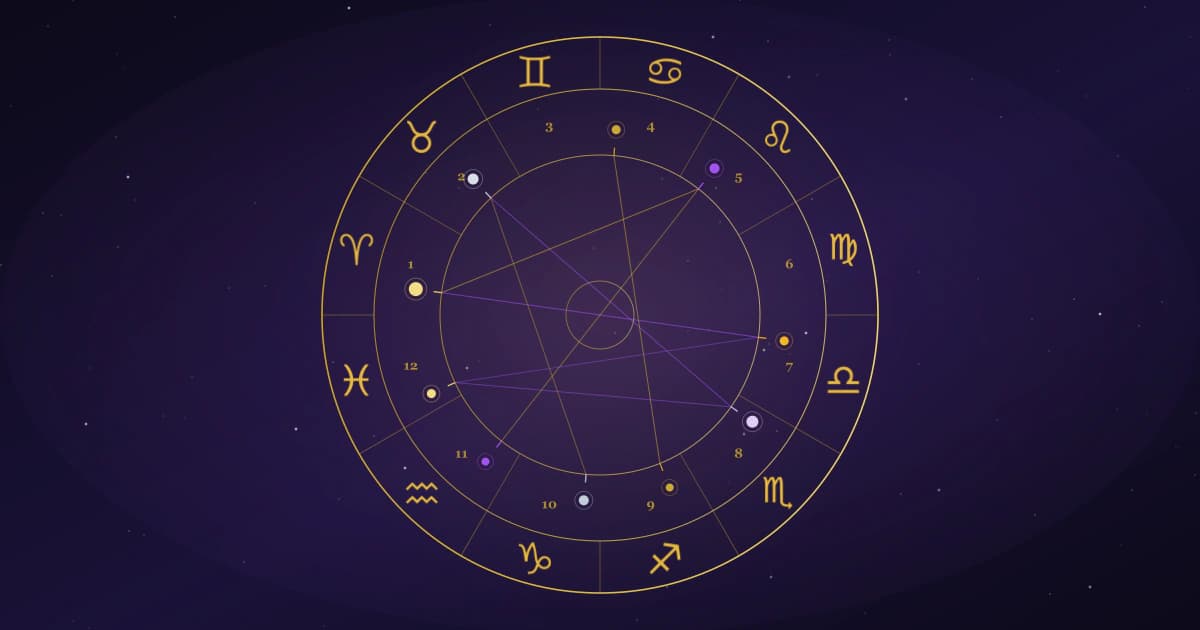
A birth chart wheel calculated from a birth date, birth time, and birthplace
A birth chart maps the sky at the minute you were born. It isn’t a general text for your sign.
1

What is a birth chart?

A birth chart (also called a natal chart) is a map of where the Sun, the Moon, and the planets were at the exact minute you were born, as seen from the place you were born. To read one, you go in order: start with your Sun, Moon, and rising sign, then look at the other planets, then the houses they sit in, and last the aspects, the angles between them. This guide walks you through each step.

The chart itself isn’t a text or a forecast. It’s the raw data: a wheel with twelve signs, twelve houses, and lines that mark the angles between planets. That’s why it’s so different from a horoscope column. A column works with one thing, the position of the Sun, which you share with about one-twelfth of the planet. A birth chart uses everything else too: the Moon, the rising sign, Mercury, Venus, Mars, and the slow outer planets. Two people with the same sign almost always have very different charts.

2

What do you need to cast a birth chart?

Three things: your birth date, your birth time, and your birthplace. The date sets which sign each planet is in. The time and place set your rising sign and the layout of the twelve houses. Time is the touchy one: the rising sign moves into a new sign about every two hours, and the house lines shift by roughly one degree every four minutes.

In the US, your birth time is usually printed on the long-form birth certificate (the short “abstract” version often leaves it out). If yours doesn’t show it, you can request the full record from the vital records office in the state where you were born. Baby books, hospital bracelets, and a parent’s memory are worth checking too.

What if you can’t find it? You can still cast a chart. The usual approach is to calculate it for noon. The planets’ signs will almost always be right (the Moon is the one exception, because it changes signs about every two and a half days), but the rising sign and the houses can’t be read from a noon chart, because they depend entirely on the time. A trustworthy tool tells you that up front and leaves those parts out. It doesn’t show you a rising sign it made up from noon.

3

How is a birth chart calculated?

The calculation is plain astronomy. Planet positions come from an ephemeris, a table of where the Sun, Moon, and planets are at any given moment. The standard one in astrology software is the Swiss Ephemeris, which is built on planetary data from NASA’s Jet Propulsion Laboratory. Your birth time and the latitude and longitude of your birthplace are then used to work out the rising sign and the house boundaries.

One useful thing follows from that: serious tools don’t disagree on the math. Your Sun lands on the same degree whether you use our site, another chart calculator, or an astrologer with printed tables. (If two sites show different houses, they’re probably using different house systems, which is a choice of method, not a mistake.) Where services really differ is the reading: what they tell you about the chart, and how clearly.

4

Step 1: How do you read your big three?

Start with three placements. Together they’re called the big three, and they give you the outline of the whole chart.

  • Your Sun sign is the sign the Sun was in on your birthday. It describes your core: what drives you and what you’re here to grow into. It’s the “sign” people mean when they ask what yours is.
  • Your Moon sign describes your emotional side: what you need to feel safe and how you react when nobody’s watching.
  • Your rising sign (the ascendant, marked ASC or AC on the wheel) is the sign that was coming up over the eastern horizon when you were born. It describes how you come across and how you walk into a room. It also sets where the first house begins, so it shapes the layout of everything else.

Here’s a quick example. Say a chart shows the Sun in Leo, the Moon in Taurus, and Virgo rising. The Leo Sun wants to make something of its own and be seen for it. The Taurus Moon needs calm, comfort, and a steady routine to feel okay. Virgo rising means the first impression is careful, modest, and a little reserved. So you get someone who seems quiet and precise when you meet them, turns out to be warm and proud once you know them, and gets cranky when their routine is disrupted. None of that fits in a one-line Leo description.

5

Step 2: What do the planets, houses, and aspects mean?

Once you have the big three, read the rest of the chart in three layers.

Planets in signs: the what and the how. Each planet stands for a part of you, and the sign it’s in shows the style. Mercury is how you think and talk. Venus is how you love and what you value. Mars is your drive and how you push for what you want. Jupiter shows where you grow easily, and Saturn shows where you’re tested and where you build discipline. Uranus, Neptune, and Pluto move so slowly that everyone born within a few years of you shares their signs, so they say more about a generation unless they sit close to one of your personal planets. A quick way to read any placement: planet plus sign. Venus in Gemini loves through conversation. Mars in Capricorn works toward a goal slowly and doesn’t quit.

The twelve houses: the where. Houses show which part of life a planet plays out in: work, relationships, home, money, health, and so on. The same Venus tells two different stories in the 7th house (partnership) and in the 10th house (career). Look first at the four angular houses, the 1st, 4th, 7th, and 10th. Planets there tend to be the loudest in a person’s life.

Aspects: how the planets get along. Aspects are the angles between planets, drawn as lines across the middle of the wheel. A trine (120°) usually means two parts of you cooperate easily. A square (90°) points to inner friction that pushes you to grow. An opposition (180°) is a pull between two sides that you learn to balance. A conjunction (0°) blends two planets into one. Don’t try to read every line. Start with the aspects to your Sun and Moon, and with the tightest ones, the angles that are within a degree or two of exact.

Put a placement together like a sentence: planet (what), sign (how), house (where), aspects (what helps or complicates it). “Mars in Capricorn in the 6th house, square the Moon” becomes: you work hard and steadily at everyday tasks, and that drive sometimes runs over your own need for rest.
6

What are the most common mistakes when reading a chart?

Reading only the Sun sign. If a reading stops at “you’re a Leo, so…,” it isn’t a chart reading. The value of a chart is in the combinations.

Taking each piece literally. A square isn’t a sentence, and the 8th house isn’t a disaster. A chart describes tendencies and themes, not fixed outcomes. For decisions about your health, your money, or your relationships, you need your own judgment and, when it matters, a qualified professional in that field.

Reading one placement in isolation. A single line like “Moon in Scorpio” can sound intense or even alarming on its own. Read it next to its house and its aspects before you decide what it means for you.

Ignoring an unknown birth time. If a tool shows you a rising sign even though you never entered a birth time, be skeptical of the rest of its reading too.

7

Online birth chart or a professional astrologer?

For the calculation, there’s no difference today. Online tools and professional astrologers draw on the same ephemeris data. A session with an astrologer makes sense when you want a conversation: the chance to ask questions, push back, and go deep on one situation. An online tool wins on access. Your chart is ready in about a minute, you can come back to it anytime, and a good service connects it to transits, meaning where the planets are right now compared with your chart. That way you use it week to week, not once.

If you’re curious how a calculated chart turns into a daily reading, we cover that in How daily horoscopes are made. For more on transits, see Astrology transits explained.

8

How do you get your birth chart on My Horoscope?

You can sign up for free and enter your birth date, birth time, and birthplace in your profile. The free Seeker plan gives you the daily horoscope for your sign and a tarot card of the day, with no end date. The full birth chart (the wheel, all twelve houses, the aspects, and a daily reading based on your chart) is part of the Cosmos plan, which is $7.49 per month.

We check our calculations against the Swiss Ephemeris. And if you don’t know your birth time, we calculate your chart without a rising sign or houses and say so plainly. We don’t fill the gap with made-up data.

You can read more about the method on our birth chart page, and the calculation itself is laid out step by step in how we calculate horoscopes.

Frequently asked questions

Q:What is a birth chart in astrology?

A birth chart, also called a natal chart, is a map of where the Sun, Moon, and planets were at the minute you were born, seen from your birthplace. It’s drawn as a wheel with twelve signs and twelve houses. Astrologers read it as a picture of your character and tendencies, not as a prediction of events.

Q:What do I need to calculate my birth chart?

You need your birth date, your birth time, and your birthplace. The date sets the planets’ signs. The time and place set your rising sign and the twelve houses. In the US, the birth time is usually on the long-form birth certificate, which you can request from your birth state’s vital records office.

Q:Can I read my birth chart without a birth time?

Yes, with limits. A chart cast for noon gives you the right signs for the planets in almost every case, though the Moon can be off on days it changes signs. Your rising sign and houses can’t be worked out without a time. An honest tool leaves those parts out and tells you so.

Q:What are the big three in a birth chart?

The big three are your Sun sign, Moon sign, and rising sign. The Sun describes your core and what drives you, the Moon describes your emotional needs, and the rising sign describes how you come across to other people. Most astrologers read these three first because they sketch the outline of the whole chart.

Q:What’s the difference between a birth chart and a natal chart?

There isn’t one. Birth chart, natal chart, and natal horoscope all mean the same thing: a diagram of the planets’ positions at the moment of birth. “Birth chart” is the everyday term, and “natal chart” is the one astrologers tend to use. You may also see “radix,” an older word for the same diagram.

Q:Do different websites calculate birth charts differently?

Serious tools don’t. They all work from the same astronomical data, so the planets land on the same degrees. Houses can differ if two sites use different house systems, such as Placidus and whole sign. The bigger difference is the reading: what a service tells you about your chart and how clearly it explains it.

Get a horoscope written for you

Sign up for free and get a daily horoscope based on your birth chart, a tarot card of the day, and deeper readings.