Give the gift of self-knowledgeChoose a gift card
Astrology13 min read

The 12 houses in astrology: what each one means

Planets say what. Signs say how. Houses say where. A complete guide to the twelve houses in a birth chart, from the 1st house of self to the 12th house of the unconscious, with a simple method for reading your own.

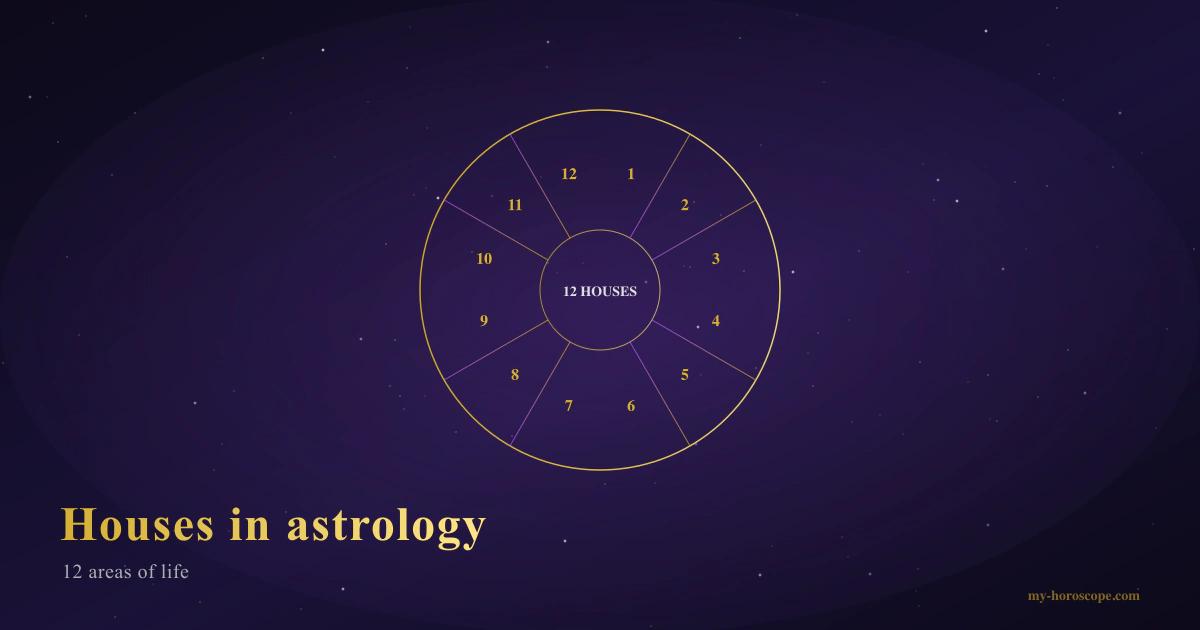
The 12 astrology houses shown as areas of life on a birth chart wheel
A birth chart divided into 12 houses, each one standing for an area of life
1

What are the houses in astrology, and why do they matter?

The houses are the twelve sections of a birth chart, and each one stands for an area of life: yourself, money, communication, home, creativity, daily work, partnership, shared resources, beliefs, career, community, and the inner life. If a sign describes how a planet acts, the house describes where in your life it shows up. Picture your birth chart as a wheel cut into twelve slices. Those slices are the houses, and they’re one of the most useful parts of astrology and one of the most misunderstood.

Say your Sun is in Leo. That points to a strong need to express yourself and be recognized. The house your Sun sits in tells you where you’ll look for that: in a partnership (7th house), in your career (10th house), at home (4th house), or in private, inward work (12th house). Without the houses, you’re reading about half of your chart.

Houses are tied to the daily rotation of the Earth, not to the planets’ slow travel through the signs. The whole wheel turns past the horizon once every 24 hours, so the sign on each house line changes about every two hours, and the lines themselves shift by roughly one degree every four minutes. That’s why you need an exact birth time to calculate them. Without one, the houses can’t be read. If you’re new to all this, start with What is a horoscope and how does it work?

2

How are the houses calculated, and why are they different sizes?

The houses are calculated from your rising sign, or ascendant: the point of the zodiac that was coming up over the eastern horizon when you were born. The ascendant is the cusp (the starting line) of the 1st house. The other eleven houses follow counterclockwise from there.

There are several house systems: Placidus, Koch, whole sign, equal house, Regiomontanus, and more. Each one uses slightly different math to divide the sky. The most widely used in modern Western astrology is Placidus, named after the 17th-century Italian monk and mathematician Placidus de Titis, who made it popular. In Placidus, the houses are unequal. One can span 20 degrees and another 50, depending on your birth latitude and the time of day.

The second most common system is whole sign, the oldest one, which goes back to Hellenistic astrology and has made a big comeback in recent years. Here every house is exactly 30 degrees, and each house lines up with one sign. It’s easier to read as a beginner. On My Horoscope, we use Placidus, because it’s the default in most Western astrology software and books.

For people born in the far north, Placidus can break down. Above the Arctic Circle, some degrees of the zodiac never rise or set on a given day, so the math has nothing to work with, and astrologers switch to whole sign or equal house. If you were born anywhere in the lower 48 states, or in most of the populated world, this doesn’t affect you.

3

What are the angular houses and the axes of a chart?

The houses don’t all carry the same weight. Traditional astrology sorts them into angular houses (1, 4, 7, 10), succedent houses (2, 5, 8, 11), and cadent houses (3, 6, 9, 12). The angular houses matter most. They begin at the four angles of the chart (the ascendant, the IC, the descendant, and the Midheaven), and planets there tend to be the most visible in a person’s life.

Every house also works as a pair with the one opposite it. Two of those pairs are the main axes of the chart, and the other four are worth knowing:

  • 1st and 7th houses: self and other. How you show up in the world (1st) and how you enter one-on-one relationships (7th).
  • 4th and 10th houses: home and public life. Your private self and your roots (4th) and your public identity and career (10th).
  • 2nd and 8th houses: what’s yours and what’s shared. Your own money, values, and body (2nd) and the resources you share with others, along with intimacy, inheritance, and deep change (8th).
  • 3rd and 9th houses: near and far. Siblings, neighbors, short trips, and everyday learning (3rd) and long journeys, higher education, philosophy, and the big picture (9th).
  • 5th and 11th houses: your own joy and the group’s. What you create and love for its own sake (5th) and the friends, communities, and causes you join (11th).
  • 6th and 12th houses: daily duty and retreat. Work, routines, and looking after your body (6th) and rest, solitude, and the inner life (12th).

If you have several planets in one of the angular houses, that’s an area where your life tends to play out in plain view. People with the Moon in the 1st house often wear their feelings on the outside, so everyone around them knows how they’re doing. People with Saturn in the 10th house often treat their career as a serious, long-term responsibility, and astrologers associate that placement with success that comes later and is built slowly.

4

What do houses 1 through 6 mean?

The first six houses deal with your personal life: your body, what you own, the people close by, your home, your creativity, and your daily routine.

  • 1st house: self and body. Your appearance, your first impression, and how you walk into new situations. The cusp of the 1st house is your rising sign. Planets in the 1st house strongly color your personality.
  • 2nd house: money and values. What you consider valuable, how you earn, and how you handle what you have. It covers self-worth as well as net worth.
  • 3rd house: communication and your surroundings. Siblings, neighbors, short trips, early schooling, texting and social media, and how you speak and write. It’s the house associated with Mercury.
  • 4th house: home and roots. The family you come from, your ancestors, your physical home, and your inner sense of safety. The cusp of the 4th house, the IC, is the most private point in the chart.
  • 5th house: creativity, play, and children. What you make, romance and dating, hobbies, and self-expression. This house shows how you enjoy your life, not only how you manage it.
  • 6th house: work, health habits, and routine. Everyday responsibilities, your job (as opposed to your career, which belongs to the 10th), the routines that keep you well, and pets.

If most of your planets are in the lower half of the chart (houses 1 through 6), much of your life plays out in private and close to home. That isn’t the same thing as being an introvert. It means your main concerns tend to be personal ones.

5

What do houses 7 through 12 mean?

The second half of the chart is about how you function in relation to other people and to something larger than yourself: partnership, career, community, and meaning.

  • 7th house: partnership. Marriage, business partners, and close one-on-one relationships. Traditional astrology also places open rivals here. The cusp of the 7th house is your descendant, which describes the kind of partner you’re drawn to, often the opposite of your rising sign. There’s more on pairing in our zodiac compatibility guide.
  • 8th house: shared resources, intimacy, and transformation. Associated with Scorpio and Pluto. Deep trust, money you share with someone (a joint account, a mortgage, insurance, an inheritance), endings and fresh starts, and the things people don’t discuss at dinner.
  • 9th house: higher learning and distance. College and beyond, philosophy, religion, long trips abroad, and your view of what life is for. This is where you look for meaning.
  • 10th house: career and reputation. Your role in society, your professional identity, and your ambitions. Some traditions also read a parent here. The cusp of the 10th house is the Midheaven (MC, from the Latin medium coeli), the highest point of the chart and your public face.
  • 11th house: groups, friends, and hopes. Your wider circle, online communities, and long-term goals. This is where you get things done together with other people.
  • 12th house: the unconscious, solitude, and the spiritual. Dreams, hidden patterns, time away from the world (traditionally hospitals, monasteries, and prisons), spiritual practice, and quiet inner work.

People with a busy 12th house often write, paint, meditate, or work behind the scenes. What they do matters, but it isn’t on display. People with a busy 10th house tend to live more publicly. Astrologers expect to see it in the charts of politicians, performers, and people who run companies.

6

What does an empty house mean?

The first time you look at your birth chart, you may notice that some houses are “empty,” with no planets in them. That’s completely normal, and it isn’t a bad sign. There are ten planets (counting the Sun and the Moon) and twelve houses, so everyone has at least two empty houses. Planets often bunch together, so most people have several.

An empty house doesn’t mean that area of your life is empty. You can have an empty 7th house and a long, happy marriage, or an empty 2nd house and a healthy bank account. It means that area is less of a focal point in your chart. Often it’s a part of life that runs along without much drama.

To read an empty house, astrologers use the house ruler: the planet that rules the sign on that house’s cusp. Say your 7th house is empty and Aries is on its cusp. Mars rules Aries, so Mars is the ruler of your 7th house, and wherever Mars sits in your chart tells you more about how partnership works for you. Mars in the 9th house might point to meeting a partner through travel or school. Mars in the 11th might point to friends and communities.

On My Horoscope, the full birth chart with all twelve houses is part of the Cosmos plan. You can compare plans on the membership page.

7

How do transits and progressions move through your houses?

The houses in your birth chart are fixed. They stay the way they were when you were born. What keeps changing is where the planets are now, compared with your houses. Those current positions are called transits. When Saturn moves into your 7th house, astrologers expect about two and a half years of taking your partnerships more seriously and testing what holds. When Jupiter passes through your 2nd house, the usual theme is growth around money or a wider sense of what you value.

Transits through the houses are one of the clearest ways astrology describes the chapters of a life. Saturn needs about 29 and a half years to go all the way around the chart. When it comes back to where it was at your birth, that’s the well-known Saturn return. Jupiter makes the trip in about 12 years. Pluto takes 248, so it can spend anywhere from 12 to 30 years in a single house.

For a quick read on what’s opening up for you right now, check which house Jupiter is moving through. Astrologers treat that as your area of growth for the coming year. We go into more detail in Astrology transits explained.

The houses also come alive through the progressed chart, a symbolic method that moves your chart forward at the rate of one day for each year of life. Over the decades, your planets progress into new houses and mark new phases. This is usually work for a professional astrologer.

8

How do you read a house in your own chart?

Take the 1st house as a worked example. Here’s the method:

  1. Find the sign on the cusp of the 1st house. That’s your rising sign, and it describes how you come across. Leo rising? Confident and warm. Pisces rising? Gentle, dreamy, sometimes a little far away.
  2. Find any planets in the 1st house. Each one adds a layer. Mars in the 1st house tends to read as energetic, direct, and sometimes impatient. Venus in the 1st house tends to read as charming and easy to like.
  3. Find the ruler of the 1st house. If you have Aries rising, the ruler is Mars. Find Mars in your chart. Wherever it is, a lot of your sense of self is tied up there. Mars in the 4th house? Home and family are central to who you are.
  4. Find the aspects to those planets. Trines support you, squares make you work, and oppositions ask you to balance two sides.

Repeat those four steps for any house you’re curious about. For relationships, read the 7th house. For career, the 10th. For money, the 2nd and the 8th. Treat what you find as themes to reflect on. A chart doesn’t make financial, medical, or legal decisions for you.

To see your own placements, you can start with a free account:

Sign up free and see your Sun, Moon, and rising sign

The houses are the stage, but the actors keep moving. The current transits pass through your houses and light up one area of life after another. And all of it rests on your birth chart, calculated from your exact birth time.

Frequently asked questions

Q:How many houses are there in astrology?

Western astrology uses twelve houses. Each one stands for an area of life: self, money, communication, home, creativity, daily work, partnership, shared resources, beliefs, career, community, and the inner life. The houses are counted counterclockwise around the birth chart, starting from the rising sign on the eastern horizon.

Q:What does the 1st house mean in astrology?

The 1st house stands for you: your body, your appearance, your personality, and the way you approach anything new. It starts at the ascendant, the point that was rising on the eastern horizon when you were born. The sign on its cusp is your rising sign, and it shapes the first impression you make.

Q:What does an empty house mean in a birth chart?

An empty house has no planets in it, and everyone has at least two. It doesn’t mean that part of your life is missing. It’s simply less of a focal point in your chart. To read it, look at the planet that rules the sign on the house’s cusp and see where that planet sits.

Q:Which house is the house of love?

It depends on the kind of love. The 5th house covers romance, dating, and fun. The 7th house covers committed partnership and marriage. The 8th house covers deep intimacy and the money and trust two people share. Astrologers usually read all three, along with Venus and Mars, to describe someone’s love life.

Q:Which house rules career?

The 10th house is the main career house. It describes your public role, your professional identity, and your ambitions, and its cusp, the Midheaven, shows what you’re known for. The 6th house matters too, because it covers your day-to-day job and work habits. The 2nd house describes how you earn.

Q:What’s the difference between Placidus and whole sign houses?

Placidus divides the sky by time, so the houses come out in unequal sizes that depend on your birth latitude. Whole sign gives every house exactly one sign, 30 degrees each. Placidus is the default in most modern Western software, and whole sign is the oldest system. Planets can land in different houses depending on which one you use.

Q:Do I need my birth time to know my houses?

Yes. The houses are calculated from your rising sign, and the horizon shifts by about one degree every four minutes. Without a birth time, the houses can’t be worked out. An honest chart tool will calculate your planets and leave the houses and rising sign out, not fill them in with a guess.

Get a horoscope written for you

Sign up for free and get a daily horoscope based on your birth chart, a tarot card of the day, and deeper readings.