Give the gift of self-knowledgeChoose a gift card
Astrology12 min read

Astrology aspects explained: trine, square, opposition, and more

Aspects are the angles between the planets in your birth chart. They show which parts of you cooperate and which ones pull against each other. Here’s what the five major aspects mean, how orbs work, and how to read the aspects in your own chart.

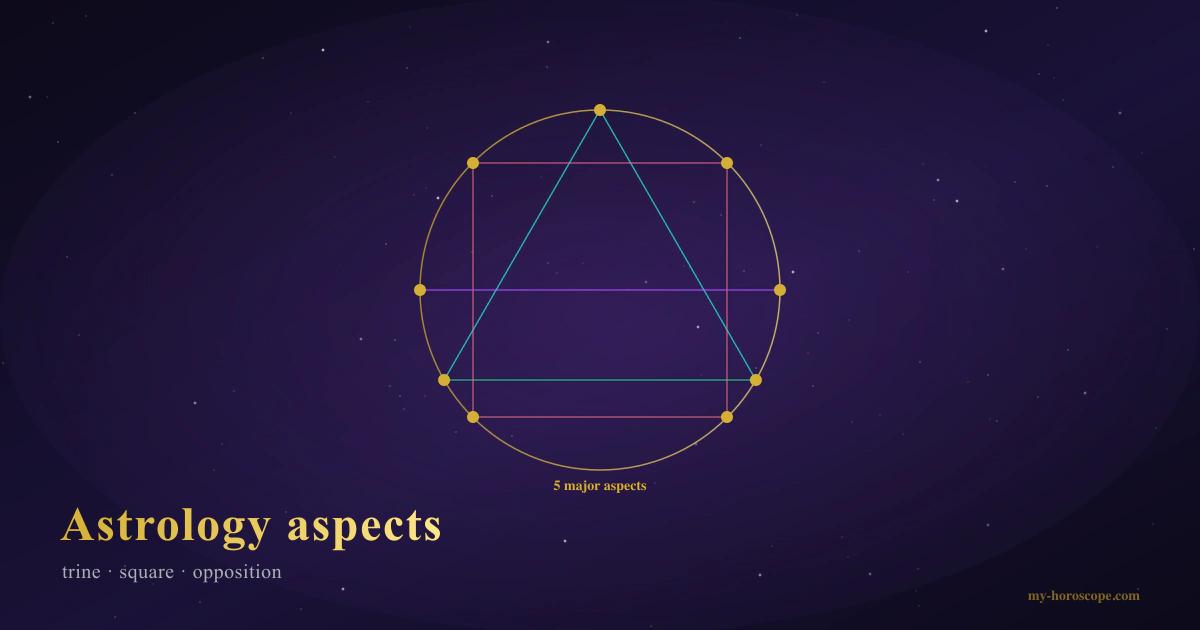
The geometry of the five major aspects in astrology drawn on a zodiac wheel
The five major aspects: conjunction 0°, sextile 60°, square 90°, trine 120°, and opposition 180°
1

What are aspects in astrology?

An aspect is the angle between two planets in a chart, measured around the zodiac wheel. Astrology reads certain angles as relationships: at some angles two planets work together easily, and at others they pull against each other. There are five major aspects: the conjunction (0°), the sextile (60°), the square (90°), the trine (120°), and the opposition (180°). So if you have “the Moon trine Venus,” those two planets were about 120 degrees apart when you were born.

Why would an angle matter? It’s a symbolic idea, not a physical one. A trine is like two friends who speak the same language. A square is like two siblings sharing one bedroom. They get on each other’s nerves, and they also shape each other.

Aspects are a big reason two people with the same Sun sign can be nothing alike. One Leo has the Sun trine Saturn and comes across as disciplined and serious. Another has the Sun square Mars and is impulsive and quick to flare up. Same sign, very different days. If signs and houses tell you what’s in a chart, aspects tell you how the pieces get along. New to all this? Start with What is a horoscope and how does it work?

2

What are the five major aspects?

Classical astrology works with five aspects, often called the Ptolemaic aspects after Claudius Ptolemy, the second-century astronomer who described them in his book the Tetrabiblos. There are minor aspects too (the semisextile at 30°, the semisquare at 45°, the quincunx at 150°), but a beginner can set them aside. The five majors cover most of what you need.

AspectAngleCharacterWhat it means
Conjunction0°IntenseTwo planets blend and act as one
Sextile60°EasyAn opening that works when you use it
Square90°ChallengingInner friction that pushes you to grow
Trine120°EasyA natural gift that flows without effort
Opposition180°ChallengingA polarity you balance, often through other people

Older astrology sorted aspects into benefic ones (the sextile and the trine) and malefic ones (the square and the opposition). Modern psychological astrology has mostly dropped that split. It prefers “easy” and “challenging,” or “soft” and “hard,” because the hard aspects are often where a person’s drive comes from.

3

Conjunction (0°): what happens when two planets meet?

A conjunction happens when two planets sit close together in the chart, usually within about 8 degrees. They merge. You don’t read them separately but as one blend. The Sun conjunct Mercury is very common, because Mercury never gets more than about 28 degrees from the Sun. It describes someone whose thinking and speaking are tightly bound up with their sense of who they are.

What a conjunction feels like depends on which planets are involved. Sun with Jupiter suggests generosity and optimism, and sometimes too much confidence. Mars with Saturn suggests discipline and stamina, and also frustration at being slowed down. Moon with Pluto suggests deep feelings and all-or-nothing closeness.

Conjunctions tend to leave a strong mark on personality, one that other people can see. If you know someone with the Sun conjunct Mars, you know a person whose identity and action are the same thing. They come across as decisive.

One special case: a planet conjunct one of the chart’s four angles (the ascendant, the Midheaven, the IC, or the descendant) is considered especially strong. Saturn on the ascendant, for example, is read as a serious, self-contained manner and a sense of responsibility that showed up early.

4

Trine (120°) and sextile (60°): what are the easy aspects?

The trine is the most harmonious aspect. Planets 120 degrees apart are normally in signs of the same element (fire with fire, water with water, and so on), so they work in a similar way and don’t get in each other’s way. Venus trine Jupiter, for instance, is read as natural charm, warmth, an eye for beauty, and a generous streak with people.

The trine has one drawback: it’s so easy that you may never use it on purpose. Astrologers often point out that people with a chart full of trines can coast on what comes naturally. A talent that costs you nothing is easy to take for granted. The charts that get the most done tend to combine trines (natural ability) with squares (the motor that makes you finish).

The sextile is the trine’s little sibling. It’s also easy, but milder. Planets 60 degrees apart are normally in compatible elements (fire with air, water with earth). Sextiles are openings, and you have to use them. A trine hands you the talent. A sextile opens a door, and you still have to walk through it.

Trines from the Sun or the Moon to the slow outer planets (Saturn, Uranus, Neptune, and Pluto) are worth a look. Because those planets stay in one sign for years, the trine links something personal in you to a theme your whole generation shares. The Sun trine Saturn, for example, is read as an easy relationship with structure, patience, and long-term effort.

5

Square (90°): is a square a bad aspect?

Squares have a bad reputation. “I have a trine, great.” “I have a square, oh no.” It doesn’t work like that. Astrologers treat squares as the aspects that build character. A chart with no friction in it has less reason to move.

Planets 90 degrees apart are normally in signs of the same modality (both cardinal, both fixed, or both mutable) but in elements that don’t mix easily, such as fire and water or earth and air. They pull you in two directions, and neither one will back down. The effort it takes to manage both is what the square is about.

A few examples of how they’re usually read:

  • Sun square Saturn: a loud inner critic and a feeling of never quite measuring up, along with a strong sense of duty. Often linked to success that comes later, after steady work.
  • Moon square Mars: quick emotional reactions, with irritation as the first response. The work is putting a pause between the feeling and the action.
  • Venus square Saturn: a sense that love has to be earned. Relationships tend to start slowly and last, and fear of rejection can be part of the picture.
  • Mars square Pluto: a powerful will that can tip into fixation. The lesson is learning when to let go.

The key to a square: don’t try to get rid of it. Put it to work. The Sun square Saturn doesn’t go away, but you can move it from “I’m never enough” to “I work steadily and build things that last.” It’s the same energy with a different strategy. These are descriptions of tendencies, though, not diagnoses. If something like anxiety or anger is making your life hard, a chart is no substitute for talking with a qualified professional.

On My Horoscope, the squares and other aspects in your own chart are part of the full birth chart in the Cosmos plan. You can see what each plan includes on the membership page.

6

Opposition (180°): what does an opposition mean?

In an opposition, two planets sit 180 degrees apart, facing each other across the chart like the two ends of a seesaw. The theme of an opposition is polarity, and its task is balance. People with a strong opposition often live out one side themselves and meet the other side in someone else.

Take the Sun opposite the Moon, which is what everyone born at a full moon has. Your conscious self (the Sun) and your emotional self (the Moon) are on opposite sides of the chart. You may often feel torn, with one part of you wanting one thing and another part wanting the reverse. This opposition tends to play out in relationships: you’re drawn to a partner who carries what you’ve set aside. One of you does the feeling and the other does the reasoning.

The trouble starts when the two sides never meet. Either you hand one side over to a partner completely, and then resent them for the very thing that attracted you, or you shut it out and live half your chart.

A few well-known oppositions:

  • Sun opposite Saturn: a strong sense of an outside authority judging you, often felt first with a parent or a boss. The grown-up version is becoming your own authority.
  • Mars opposite Venus: wanting versus pleasing, pursuit versus harmony. The attraction of opposites is a running theme.
  • Moon opposite Pluto: emotional intensity, and a habit of seeing partners as either rescuers or threats until you learn to own that intensity yourself.

Worth knowing: oppositions between the 1st and 7th houses (the “me and you” axis) show up especially clearly in relationships. If you have several planets in the 1st or the 7th house, partnership is likely to be one of the main themes of your life. Our guide to the 12 houses explains why.

7

What is an orb in astrology?

An aspect is almost never exactly 0°, 60°, 90°, 120°, or 180°. It’s always off by a little. So astrologers work with an orb: the margin on either side of the exact angle within which the aspect still counts. With an orb of 6 degrees, two planets 96 degrees apart are still in a square.

There’s no single rulebook, and orbs vary from one astrologer and one program to the next. Common guidelines look like this:

  • Conjunction, opposition, square, and trine: about 6 to 8 degrees, and up to 10 when the Sun or the Moon is involved.
  • Sextile: about 4 to 6 degrees, because it’s a milder aspect.
  • Minor aspects (semisextile, quincunx, and others): 1 to 3 degrees, and only if you want to go deeper.

The tighter the aspect, the stronger it’s considered. A trine with an orb of 1 degree counts for much more than the same trine with an orb of 7. That’s why two chart tools can list slightly different aspects for the same birth data. They’re using different orbs, not different planets.

Applying and separating aspects: if the faster planet is still moving toward the exact angle, the aspect is applying. If it has already passed the exact angle and is moving away, the aspect is separating. Traditionally, an applying aspect is given more weight, because it’s still building.

8

How do you read the aspects in your own chart?

The first time you open a birth chart with the aspects drawn in, you see a tangle of lines across the middle. Depending on the orbs, there might be 20 or 30 of them. You don’t have to decode them all at once. Go in this order:

  1. Start with the aspects to your Sun and Moon. These two are the core of your personality. Aspects to the Sun describe how your sense of self operates. Aspects to the Moon describe your emotional patterns.
  2. Focus on the tight aspects, with an orb under 3 degrees. These are the ones you’re most likely to recognize in yourself, and the ones other people notice.
  3. Find the hardest aspect. You probably know it already, because it tends to be a recurring theme. Mars square Saturn? Learning to work with frustration and delay. Venus opposite Pluto? Intensity in relationships.
  4. Look for patterns. If Saturn makes three squares in your chart, Saturn’s themes (limits, responsibility, patience) are a big part of your story. If Jupiter makes several trines, optimism and good timing come easily to you.

Here’s how that looks in practice. Say a chart has the Sun in Gemini square the Moon in Virgo with a 2 degree orb, and Venus in Taurus trine Saturn in Capricorn with a 5 degree orb. The square is tighter and involves both the Sun and the Moon, so read it first: a quick, curious mind (Gemini Sun) that’s regularly second-guessed by an inner editor who wants everything correct (Virgo Moon). The trine is wider and comes second: steadiness and loyalty in love, which is probably something this person never thinks about, because it’s never been a problem.

Aspects also matter in transits, which compare where the planets are right now with your birth chart. When transiting Saturn squares the Sun in your chart, for example, astrologers describe a testing stretch of several months, often in up to three passes because of Saturn’s retrograde. We cover that in Astrology transits explained.

If you want to see your own placements, you can start with a free account. Your Sun, Moon, and rising sign appear in your profile, and the full chart with its aspects is part of the Cosmos plan.

Sign up free or read more about the birth chart first.

Frequently asked questions

Q:What is an aspect in astrology?

An aspect is the angle between two planets in a chart, measured around the zodiac. Astrology reads certain angles as relationships between the planets. The five major aspects are the conjunction (0°), the sextile (60°), the square (90°), the trine (120°), and the opposition (180°). They show which parts of a chart cooperate and which create tension.

Q:What is a trine in astrology?

A trine is a 120° angle between two planets, and it’s considered the most harmonious aspect. Planets in a trine are normally in signs of the same element, such as two fire signs or two water signs, so they work together without friction. Astrologers often describe a trine as a natural gift or talent.

Q:Is a square a bad aspect?

Not bad, but demanding. A square is a 90° angle between two planets that pull in different directions. Older astrology called it malefic. Modern astrologers see squares as the source of drive, because the tension pushes you to act and to develop skills you wouldn’t build otherwise. Most charts have several of them.

Q:What does orb mean in astrology?

An orb is the margin an astrologer allows around an exact aspect. Planets are rarely exactly 90° or 120° apart, so an aspect still counts if it’s within a few degrees. Common orbs are 6 to 8 degrees for major aspects and less for minor ones. The tighter the orb, the stronger the aspect is considered.

Q:How many aspects are in a birth chart?

With ten planets there are 45 possible pairs, but only some of them fall within orb of an aspect. A typical chart shows somewhere around 20 to 30 major aspects, depending on the orbs used. You don’t need to read them all. Start with the tightest ones and with those involving the Sun and the Moon.

Q:What’s the difference between a conjunction and an opposition?

In a conjunction (0°), two planets sit together and blend into one, so their themes are hard to separate. In an opposition (180°), they face each other across the chart and pull in opposite directions. A conjunction is felt as one intense focus. An opposition is a balancing act that often plays out through other people.

Q:What’s the difference between an applying and a separating aspect?

An aspect is applying when the faster planet is still moving toward the exact angle, so the aspect is getting tighter. It’s separating when the faster planet has already passed the exact angle and is moving away. Traditional astrology gives applying aspects more weight, because they’re still building toward their peak.

Get a horoscope written for you

Sign up for free and get a daily horoscope based on your birth chart, a tarot card of the day, and deeper readings.