Give the gift of self-knowledgeChoose a gift card
Tarot12 min read

Tarot for beginners: how to read the cards

New to tarot? This guide covers all 78 cards, the Major and Minor Arcana, the three spreads worth learning first, and how to try a free card of the day on My Horoscope.

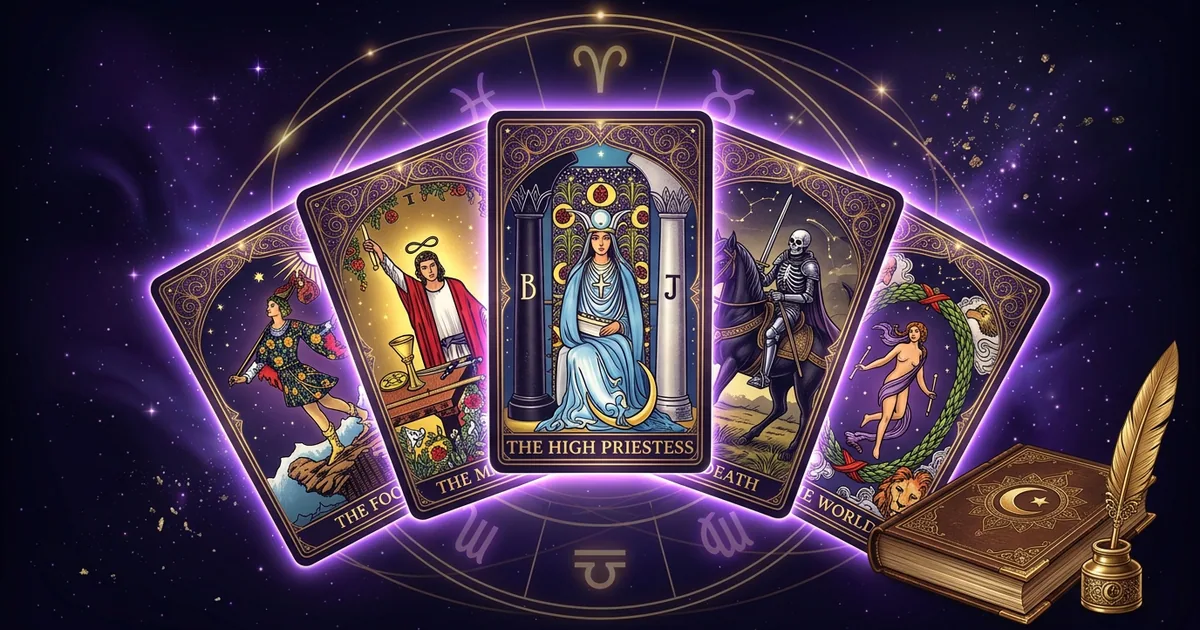
Five tarot cards from the Major Arcana fanned out on a dark background
Five Major Arcana cards: the Fool, the Magician, the High Priestess, Death, and the World
1

What is tarot, and how does it work?

Tarot is a deck of 78 illustrated cards used for reflection. You ask a question, pull one or more cards at random, and read what their images and traditional meanings suggest about your situation. The deck has two parts: the Major Arcana (22 cards about big life themes) and the Minor Arcana (56 cards about everyday life). To start reading tarot, you need three things: a rough idea of what the cards mean, a clear question, and a simple layout, called a spread.

Despite its reputation, tarot doesn’t have to be fortune-telling. Most people who use it today treat it as a mirror for whatever is going on right now. A card gives you an image and a theme. You supply the context. That’s often enough to see a problem from a different angle, notice a motive you’ve been ignoring, or put words to a feeling before a big decision.

The cards themselves are older than their mystical reputation. Tarot appeared in northern Italy in the 1400s as a card game, and people played it for more than 300 years before anyone used it for readings. The link to the occult came from France in the late 1700s. The full story, including the 1909 deck that most modern readers use, is in our history of the Rider-Waite-Smith tarot. If you’d rather learn by doing, you can try a tarot reading online and come back to the theory later.

2

What is the Major Arcana?

The Major Arcana runs from the Fool (0) to the World (XXI). These 22 cards stand for the big chapters of a life: starting out, falling in love, losing something, changing direction, finding your feet again. They’re the cards most people recognize even if they’ve never held a deck, such as Death, the Lovers, and the Tower.

When a Major Arcana card shows up in a reading, it usually points to a larger lesson or a turning point, not a passing mood. If most of the cards in a spread come from the Major Arcana, the question probably touches something that matters more than it first appeared to.

Read in order, the 22 cards tell a story known as the Fool’s Journey, a phrase popularized by the American tarot writer Eden Gray. The Fool sets out knowing nothing, meets teachers (the Magician, the High Priestess, the Hierophant), runs into trouble (the Devil, the Tower), and comes out the other side in the World. You don’t have to memorize it. But once you see the cards as stages of one journey, they’re much easier to remember than 22 separate definitions.

3

How do you read tarot cards?

Every reading starts with a question. It can be specific (“What can I do to improve things with my sister?”) or open (“What do I need to know about this month?”). Open questions that start with “what” or “how” work better than yes-or-no questions, because they give the cards room to say something useful.

Next, you shuffle and place the cards in a spread: a layout where each position has a job. The most common one is the three-card spread (past, present, future). The best-known detailed one is the Celtic Cross, with 10 cards. The position changes how you read the card. The Three of Swords in the “past” position is a hurt you’re recovering from. The same card in the “advice” position may be asking you to stop avoiding a painful truth.

Then you read the cards one at a time and as a group. Start with what you see: who’s in the picture, what are they doing, how does it feel? Add the traditional meaning. Then look at how the cards relate. Do they tell a story from left to right? Is one suit everywhere? The connections usually say more than any single card.

Cards can land upright or reversed. A reversed card usually means its theme is blocked, delayed, or turned inward. Strength reversed, for example, can point to self-doubt or courage you’re holding back. Some readers use reversals and some don’t. Both approaches are common, and as a beginner you can skip reversals until the upright meanings feel familiar.

A worked example. You ask, “What’s going on with my job search?” and pull three cards: the Eight of Pentacles, the Hermit, and the Ace of Wands. Past: you’ve been putting in steady, careful work. Present: you’ve pulled back to think, maybe a little too far. Future: a new spark, if you act on it. Put together, the reading says something like “you’ve done the groundwork, and it’s time to stop researching and send the application.” That’s the whole method, just with more cards and more practice.

4

How does an online tarot reading work?

An online reading follows the same steps as one with a physical deck. The cards are shuffled at random, placed into the positions of a spread, and read against your question. A digital shuffle is as random as a shuffle by hand, so the difference between a good online reading and a poor one comes down to the reading itself, not the shuffle.

On My Horoscope, the simplest option is the card of the day: one card with a full reading that also takes the day’s planets into account. With a free account you get one pull a day. For bigger questions there are member spreads where you type your own question and get a reading for each position plus a summary that ties the cards together. There are 12 types of readings in all, from the single daily card to the 10-card Celtic Cross and a 13-card yearly reading.

Member spreads are part of a paid plan: Star ($4.49 a month) includes 5 in-depth readings a month, and Cosmos ($7.49) and Oracle ($9.49) include 15. You can also buy a single extra reading for $1.99 without a membership. We use the full 78-card Rider-Waite-Smith deck, reversals included. You can see every option on the tarot reading page.

5

What do the 22 Major Arcana cards mean?

NumberCardLook forCore meaning
0The Foolwhite dog, cliff edgenew beginnings, spontaneity, freedom
IThe Magicianwand, infinity signwillpower, focus, skill
IIThe High Priestesscrescent moon, veilintuition, secrets, the subconscious
IIIThe Empresswheat field, crown of starsabundance, creativity, nurturing
IVThe Emperorstone throne, ram’s headsauthority, structure, protection
VThe Hierophantcrossed keys, blessing handtradition, teaching, shared beliefs
VIThe Loversangel, blazing sunlove, choice, values
VIIThe Chariottwo sphinxes, starry canopydrive, direction, self-control
VIIIStrengthwoman and lioncourage, patience, quiet strength
IXThe Hermitlantern, staffsolitude, searching, wisdom
XWheel of Fortunesphinx, snakecycles, luck, change
XIJusticesword, scalesfairness, truth, consequences
XIIThe Hanged ManT-shaped tree, halopause, a new angle, letting go
XIIIDeathskeleton in armor, white roseendings, transformation, a fresh start
XIVTemperanceangel, two cupsbalance, patience, healing
XVThe Devilchains, hornsattachment, temptation, illusion
XVIThe Towerlightning, falling figuressudden change, release, crisis
XVIIThe Stareight stars, flowing waterhope, renewal, inspiration
XVIIIThe Moondog and wolf, crayfishuncertainty, fear, dreams
XIXThe Sunsun, child on a white horsejoy, success, vitality
XXJudgementangel with a trumpet, open tombsawakening, reckoning, a calling
XXIThe Worldwreath, dancercompletion, wholeness, a full cycle

The table is a starting point, not the full story. Each card has more layers than three keywords can hold, and each name links to a page with the full meaning, upright and reversed. The symbols listed are the ones you’ll see in the Rider-Waite-Smith deck, first published in London in 1909. It’s the most widely used tarot deck in the English-speaking world, and most books and courses for beginners are written around it.

Two cards scare beginners more than they should. Death (XIII) almost never means a literal death. It marks the end of one chapter and the start of another: a job, a habit, a version of yourself. The Tower (XVI) isn’t a prediction of disaster either. It shows a structure built on a bad foundation coming down, which is often a relief in hindsight. In both cases the position in the spread, the orientation, and the cards nearby tell you how to read it.

The best way to learn these 22 cards is slowly. Pull one card each morning, look at the picture before you read anything about it, and check in at night to see where its theme showed up. A few weeks of that will teach you more than memorizing a list. Our guide to the tarot card of the day walks through the habit step by step.

6

What are the four suits of the Minor Arcana?

The Minor Arcana has 56 cards in four suits. Each suit is tied to an element and a part of everyday life:

  • Cups (water): feelings, relationships, intuition. Cups show how you feel and how your connections with other people are shaping your life.
  • Swords (air): thoughts, words, conflict, decisions. Swords often point to a mental struggle, a hard truth, or the need to think clearly.
  • Wands (fire): action, creativity, drive, ambition. Wands are about inspiration and the energy you put into projects and goals.
  • Pentacles (earth): money, work, home, the body. Pentacles deal with practical matters and the things you can touch.

Each suit has 14 cards: an Ace, the numbers two through ten, and four court cards (Page, Knight, Queen, and King). The numbers follow a rough arc. Aces are beginnings, fives tend to bring friction or loss, and tens show a theme taken as far as it can go. Court cards often stand for a person in your life or a role you’re playing yourself. The Page is the student, curious and new. The Knight is in motion. The Queen has mastered the suit inwardly, and the King directs it outwardly.

A quick trick for beginners: combine the number and the suit. A Five (friction) of Cups (feelings) is grief or disappointment. An Ace (beginning) of Pentacles (money and work) is a new job, a first paycheck, or a practical opportunity. You’ll be right more often than you’d expect, and the picture on the card fills in the rest.

7

Which tarot spreads should a beginner learn first?

A spread is the layout you place the cards in. Picking one that fits the size of your question matters more than picking a fancy one. These three cover almost everything, from simplest to most detailed:

1. One card: the card of the day

You pull a single card for the day’s theme or for one simple question. It’s the best place to start, because one card is easy to remember and you can test it against your actual day. Done daily, it’s also the fastest way to get to know the deck.

2. The three-card spread

The most popular spread there is. Three cards in a row, usually read as past, present, future or as situation, action, outcome. It gives you enough context for a real reading without burying you in cards. If you learn only one spread, learn this one.

3. The Celtic Cross (10 cards)

The classic in-depth spread. It uses 10 cards, and each position answers a different question. Position names vary a little from one reader to the next. This is a common version:

  1. The present: the heart of the question, what you’re facing now
  2. The challenge: the obstacle or influence crossing your path
  3. The foundation: the deeper roots of the situation
  4. The recent past: events that led up to this point
  5. The best possible outcome: what you could reach if things go well
  6. The near future: what’s likely in the coming days or weeks
  7. Your approach: how you see the situation and respond to it
  8. Outside influences: the people and circumstances around you
  9. Hopes and fears: what you’re wishing for and what you’re dreading
  10. The outcome: where things are heading if nothing major changes

The Celtic Cross suits a complicated question where you need the whole picture. It’s a lot to take in on day one, so start small. Three cards you understand will tell you more than 10 cards you get lost in. On My Horoscope you can try the card of the day, the three-card spread, and the Celtic Cross online.

Frequently asked questions

Q:What is tarot, and how does it work?

Tarot is a deck of 78 illustrated cards used for reflection. You ask a question, pull cards at random, and read their symbolism in light of your situation. The meaning comes from three things together: the card, its position in the spread, and the question you asked. It works as a mirror, not a prediction machine.

Q:Can I teach myself to read tarot?

Yes. Most readers are self-taught. Start with the Rider-Waite-Smith deck, because nearly every beginner book is written for it. Pull one card a day, describe the picture before you look up the meaning, and keep short notes. After a month or two, move on to the three-card spread. Regular practice matters more than memorizing all 78 definitions.

Q:Do I have to believe in the supernatural to use tarot?

No. Plenty of people use tarot purely as a tool for self-reflection, much like journaling or meditation. The cards give you an image and a theme to think with, and the insight comes from you. You can find a reading useful without believing the cards know anything about your future.

Q:What’s the difference between the Major and Minor Arcana?

The Major Arcana has 22 cards, from the Fool to the World, and deals with big life themes and turning points. The Minor Arcana has 56 cards in four suits (Cups, Swords, Wands, and Pentacles) and describes everyday situations, feelings, and practical matters. A reading full of Major Arcana cards usually points to something important.

Q:Can tarot predict the future?

Tarot doesn’t show a fixed future. A reading describes where things stand now and where they’re likely heading if nothing changes, which means you can still change it. Treat any reading as a prompt for reflection and entertainment, never as a guarantee, and not as medical, legal, or financial advice.

Q:Is it bad luck to buy your own tarot deck?

No. The idea that your first deck has to be a gift is a modern superstition with no roots in tarot history. Most readers buy their own decks. Choose one whose pictures you like and can read easily. For learning, a Rider-Waite-Smith deck or a close variation is the most practical choice, because most guides refer to its images.

Q:How many types of tarot readings does My Horoscope offer?

There are 12, from a single card of the day to the three-card spread, the 10-card Celtic Cross, and a 13-card yearly reading. The card of the day is free once a day with a free account. Readings with more cards and your own question are included in a membership, or you can buy a single extra reading for $1.99.

Get a horoscope written for you

Sign up for free and get a daily horoscope based on your birth chart, a tarot card of the day, and deeper readings.