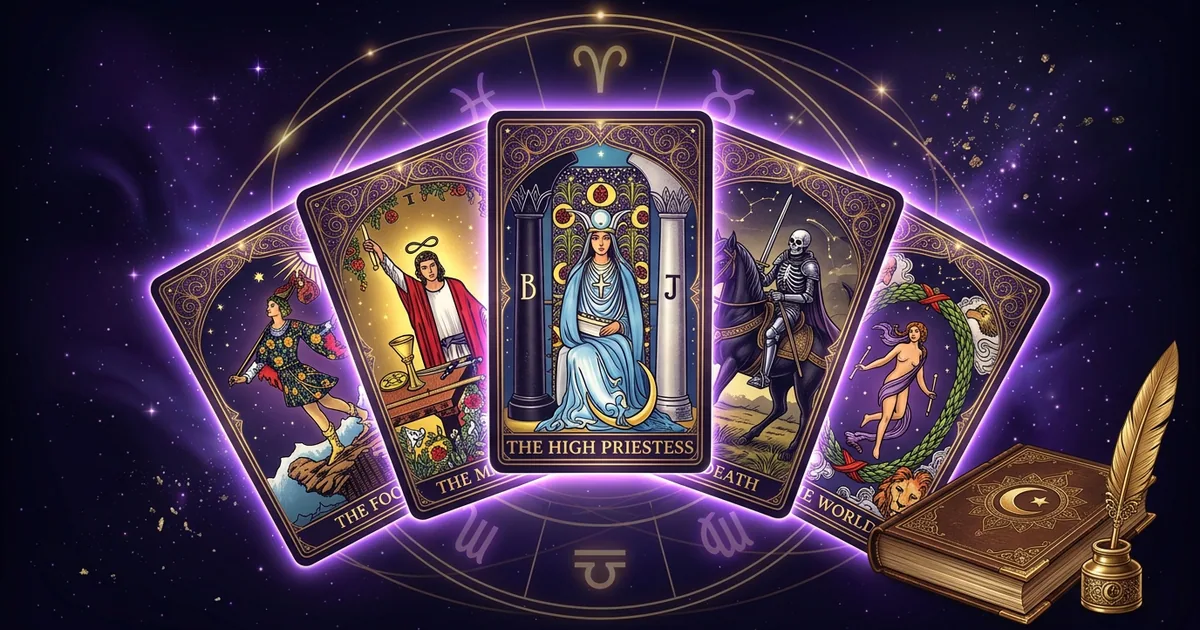
Tarot is a deck of 78 illustrated cards used for reflection. You ask a question, pull one or more cards at random, and read what their images and traditional meanings suggest about your situation. The deck has two parts: the Major Arcana (22 cards about big life themes) and the Minor Arcana (56 cards about everyday life). To start reading tarot, you need three things: a rough idea of what the cards mean, a clear question, and a simple layout, called a spread.
Despite its reputation, tarot doesn’t have to be fortune-telling. Most people who use it today treat it as a mirror for whatever is going on right now. A card gives you an image and a theme. You supply the context. That’s often enough to see a problem from a different angle, notice a motive you’ve been ignoring, or put words to a feeling before a big decision.
The cards themselves are older than their mystical reputation. Tarot appeared in northern Italy in the 1400s as a card game, and people played it for more than 300 years before anyone used it for readings. The link to the occult came from France in the late 1700s. The full story, including the 1909 deck that most modern readers use, is in our history of the Rider-Waite-Smith tarot. If you’d rather learn by doing, you can try a tarot reading online and come back to the theory later.