How we calculate your horoscope
No recycled templates. No text written “for all Scorpios.” Every horoscope starts from real planetary positions, pulled from the professional ephemeris library Swiss Ephemeris. Astrologers around the world rely on the same library. Here’s exactly how we use it.
12/12
Test charts verified
1900 to 2050
Date range
Placidus
House system
±1 min
Sun sign change
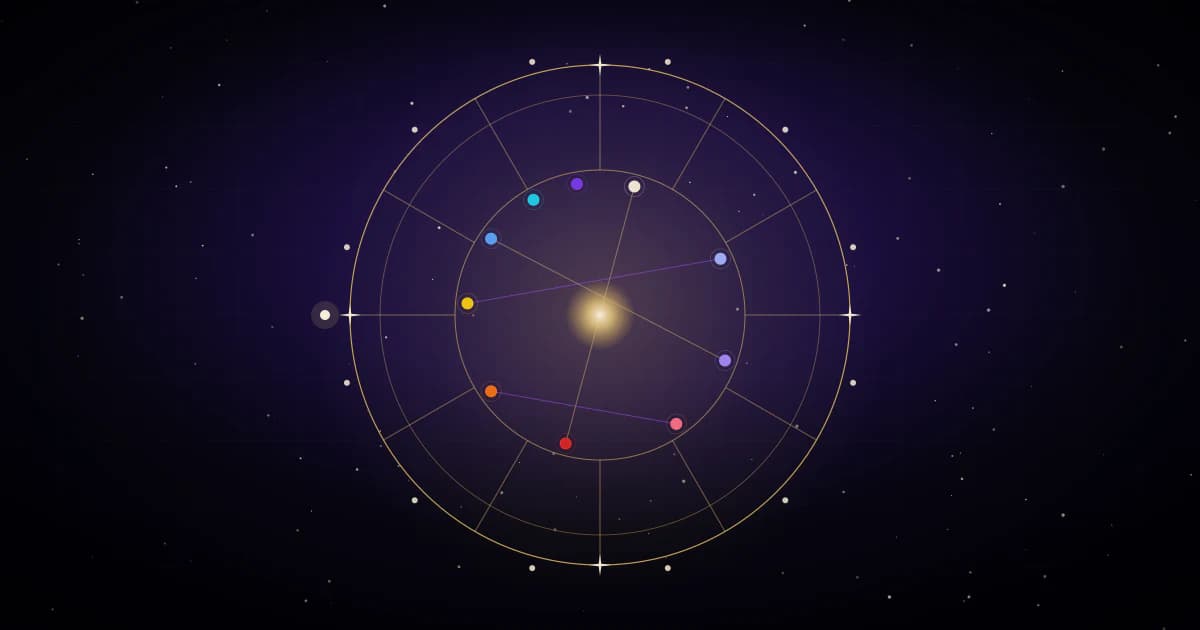
1. Astronomical data, not editorial templates
Many horoscopes you find online are written in advance and rotated out of a database. “Scorpios are in for a great week” is a template, not a calculation. We do it differently.
All our planetary positions come from Swiss Ephemeris, an open-source ephemeris library from the Swiss company Astrodienst, built on NASA JPL’s Development Ephemerides (DE431/441). It’s the library behind astro.com and many professional astrology programs. Its positions are exact to under one arcsecond, about 0.00028 of a degree.
In production we use a commercial API, astrology-api.io (V1 endpoint), which runs the same Swiss Ephemeris under the hood. Our local reference is pyswisseph, the Python port. We cross-checked the two on 12 test birth dates between 1900 and 2050. All 10 planets, the Ascendant, and the Midheaven matched in 12 of 12 cases, including dates in tricky historical daylight saving periods.
What we calculate
10 planets (Sun, Moon, Mercury, Venus, Mars, Jupiter, Saturn, Uranus, Neptune, Pluto), the Ascendant, the Midheaven, and the major aspects with their orbs.
Where it comes from
Swiss Ephemeris (NASA JPL DE431/441), the reference standard for professional astrology in Europe and North America.
How exact
Under 1 arcsecond, roughly 0.00028°. That’s far more than a horoscope needs.
2. Placidus houses, the professional standard
A chart is divided into 12 houses, sectors that stand for different areas of life (self, money, communication, home, creativity, health, relationships, transformation, meaning, career, friends, the subconscious). There are several ways to calculate them: Placidus, Koch, Equal House, Whole Sign, Regiomontanus, Campanus, and others.
We use Placidus, the most widely used system in Western astrology since the 17th century. Houses are calculated from the exact date, hour, minute, and location of your birth. So you get your own chart, not a generic wheel “for Leos.”
What that means for you: your exact birth time changes your rising sign (the Ascendant, the face you show the world) and the boundaries of every house. If you only know the time roughly (say, “sometime between seven and eight in the morning”), your rising sign can shift by a whole sign.
3. Born on the cusp: the exact minute the Sun changes signs
Most horoscopes online use a simple rule: “The Sun enters Aries on March 21, Taurus on April 20…” That rule can be off by up to 18 hours, and it shifts from year to year. Take 1998: the Sun entered Virgo on August 23 at 9:59 AM Central European Summer Time, not at midnight. Someone born that day at 6:23 AM in Prague is still a Leo, not a Virgo. A simple calendar would file them under Virgo.
We solve this with an ingress table generated from Swiss Ephemeris for the years 1900 to 2050. It’s 80 KB and holds the time, to the minute, when the Sun enters each of the 12 signs in each year. When you enter your birth details, we look it up and give you the right Sun sign down to the minute.
This correction matters for about 1% of people, those born on the days when the sign changes (usually the 20th to the 23rd of the month). For everyone else, the result matches the simple calendar.
4. Historical daylight saving time, so older birth dates come out right
Daylight saving rules have changed many times over the last century, and every country did it differently. That’s a common source of errors for people born in the 1950s through the 1970s. One example: Czechoslovakia had no daylight saving time from 1950 to 1978. Central European Summer Time has applied there since 1979, and its start and end dates have moved several times since.
Some tools apply daylight saving time to dates when it wasn’t in effect. That shifts the Ascendant by an hour, which can change the rising sign. We handle historical time changes automatically through tzdata (the IANA time zone database), based on where you were born. If you were born on July 15, 1965, at 2:00 PM in Brno, we calculate your Ascendant without a daylight saving shift.
Example: 1950 to 1978
No daylight saving time. Prague = UTC+1 (CET) all year.
1979 → today
Standard DST. Prague = UTC+1 (CET) in winter, UTC+2 (CEST) in summer.
5. Two layers of content: public and personal
Our content has two clearly separate layers, so you always know what you’re looking at:
12 daily horoscopes for 12 signs
Every day at midnight we pull the current planetary positions and put together twelve daily horoscopes, one for each sign. This layer is free forever on the Seeker plan.
- Current planetary transits (Sun, Moon, Mercury, Venus, Mars)
- The Moon phase and the aspect of the day
- 12 distinct horoscopes by Sun sign
- Updated daily at 12:05 AM Central European Time
Your own birth chart
Your exact birth date, time, and place give us a complete Placidus birth chart. From it, we write a horoscope just for you every day, based on the current transits.
- Birth chart (10 planets, Ascendant, Midheaven, 12 houses, aspects)
- Daily, weekly, and monthly readings from your own chart
- Current transits to all your natal planets
- Erotic horoscope, spirit animal, and dream interpretation, all personalized
The first layer answers “what’s today like for my sign.” The second answers “what’s today like for me.” We think both have their place: your Sun sign is a good starting point, and your own chart is where the depth is.
6. Security and privacy: your data is stored in the EU
Your birth date, time, and place stay with you for life. They deserve the same care as medical records. So:
- Encryption at rest (AES-256-GCM): all sensitive data in the database is encrypted, and it can’t be read without the master key.
- European infrastructure: our database runs on Supabase in Frankfurt, Germany, and that’s where your data is stored. When we create a reading for you, we pass only what’s needed to the processors listed in our Privacy Policy. Some are based in the US. They don’t keep your data, and the transfer is covered by standard contractual clauses.
- GDPR compliant: you have the right to export, correct, and delete all your data. You can delete your account with one button in Settings.
- We don’t sell data: we don’t give your details to ad networks or other third parties. We’re funded entirely by memberships.
7. How we calculate your karmic map
The karmic map reads your birth chart through the lens of karmic astrology. It’s built from seven layers, each calculated deterministically: the lunar node axis (sign and house of the South and North Node), the ruler of the South Node by modern rulerships, planets on the nodal axis (a planet conjunct a node or square the axis, with an orb of 3° at most), Pluto and its polarity house and sign, Saturn along with retrograde personal planets, Chiron and the 12th house, and finally timing: the prenatal eclipse, the nodal return, and the transiting node today (orb of 2° at most).
We read from a specific tradition: the evolutionary astrology of Jeffrey Wolf Green’s school, the work of Steven Forrest and his book Yesterday’s Sky, and the classical karmic tradition. This is a symbolic tradition, not a measurable fact, and we say exactly that to members right in the map.
We use the mean node: it’s stable, and the evolutionary tradition prefers it. The true node wobbles and can differ by up to about 1.75°, so a borderline contact with the axis may come out differently with the true node. We’re upfront about that. The lunar nodes aren’t bodies, either. They’re calculated points where the Moon’s orbit crosses the ecliptic. We say that openly too.
Our orb policy is strict: planets on the nodal axis at 3° at most, the transiting node at 2° at most, and we never stretch an orb to make a reading sound more interesting. We also skip generational contacts, the things everyone born in the same year shares (for example, Pluto conjunct Pluto for everyone your age).
Orbs: 3° / 2°
Planets on the nodal axis 3° max, transiting node 2° max. We never stretch orbs.
Node: mean
A stable mean node. The true node wobbles and can differ by up to about 1.75°.
Eclipses: 1920 to 2030
Our own table of solar eclipses, generated from ephemerides.
For the timing layer we use our own table of solar eclipses from 1920 to 2030, generated from ephemerides (new moons where the Moon’s ecliptic latitude is under 1.55°). We take the last eclipse before your birth, along with its degree and house in your chart. The nodal return comes from a deterministic mean node formula with an 18.6-year cycle, dated to the day.
If you don’t know your exact birth time, the karmic map runs on signs only: no houses, no Ascendant, no Midheaven, and no Moon, because the Moon moves about 13° in a single day. We’d rather tell you less and stand behind it.
The written reading is based only on the calculated layers, and it goes through an automatic check: it can’t mention a house that isn’t in your chart.
The karmic map is part of the Cosmos and Oracle plans. For everything the map says about a past life, see Past life.
Frequently asked questions
›What do you calculate horoscopes from?
From real planetary positions provided by Swiss Ephemeris, the reference ephemeris library used in professional astrology and built on NASA JPL’s Development Ephemerides. No templates, no rotating editorial text.
›What’s a natal chart, and do you calculate one?
A natal chart is another name for a birth chart, a map of the sky at the moment you were born. Yes, we calculate the whole thing: 10 planets in signs and houses, the Ascendant, the Midheaven, 12 Placidus houses, and aspects with orbs. You see it as a chart wheel and as a plain-language list with a reading.
›Which house system do you use?
Placidus, the professional standard in Western astrology. Houses are calculated from the exact date, time, and place of birth, so every member gets their own birth chart.
›How do you handle daylight saving time for older birth dates?
Daylight saving rules have changed many times, and differently in every country. Czechoslovakia, for example, had no daylight saving time from 1950 to 1978. The tzdata library handles these historical changes automatically, so the rising sign and Moon come out right for older birth dates too.
›What if I was born on the cusp between two signs?
The usual rule, “the Sun moves into the next sign at midnight between the 20th and 23rd of the month,” isn’t exact. The actual moment (the ingress) shifts by up to 18 hours from year to year. We use an ingress table generated from Swiss Ephemeris for 1900 to 2050 that gives the time to the minute. So people born on the cusp get the right Sun sign.
›How do you check that your engine is right?
We checked our calculation engine (astrology-api.io, V1 endpoint) against pyswisseph, the Python port of Swiss Ephemeris, on 12 historical dates between 1900 and 2050. It matched 12 out of 12: all 10 planets, the Ascendant, and the Midheaven agree within ephemeris precision (under 1 arcsecond).
›What if I don’t know my exact birth time?
You can say so when you fill out your profile. We then use 12:00 PM (noon) as a safe midpoint and leave the rising sign and houses out of your readings, because they can’t be determined without an exact time. Your Sun and most planetary positions stay reliable.
›What do you do with my data?
We store your birth date, time, and place encrypted (AES-256-GCM) on European infrastructure (Supabase, Frankfurt). We don’t sell it or share it with ad networks. You can delete your account anytime, and all your data goes with it. We comply with GDPR.
Get a horoscope based on real astronomical data
The daily horoscope for your sign is free forever, with no credit card and no commitment. Your own birth chart with 12 houses comes with Cosmos for $7.49 per month.
No credit card, no commitment. Cancel anytime.